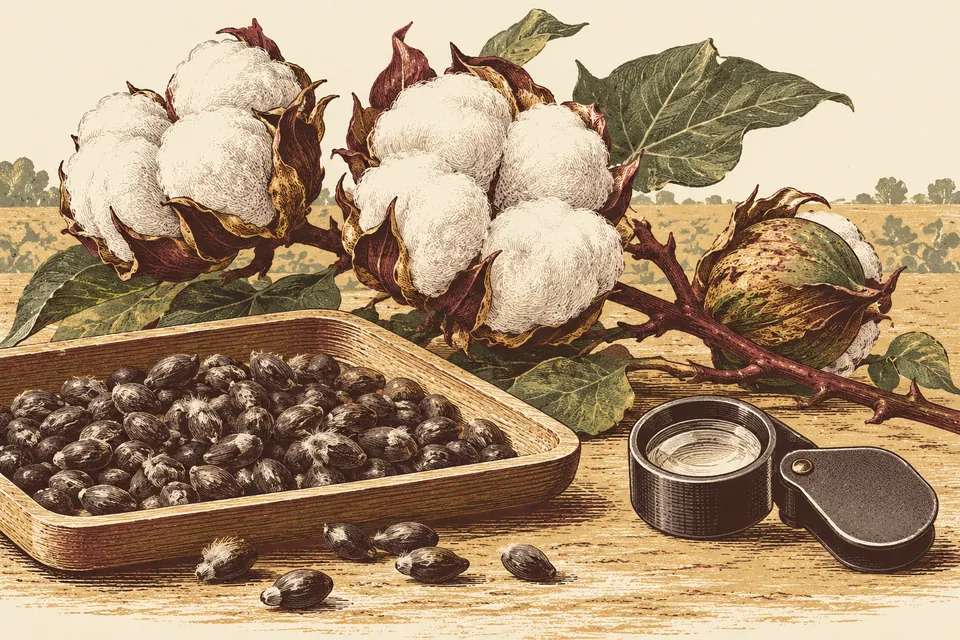
AI-generated symbolic illustration. Concept of cotton and seed inspection; no actual field, identification of Halab 90, seed certification or measured yield is depicted. · Agriculture / Haber Paper
Story details
Cotton researchers in Syria used a field day near Tal Tamr in Hasakah governorate to explain the locally developed Halab90 variety and warn against seed of unknown origin. State news agency SANA published its report on October 23, describing an event held on Thursday, October 22, in al-Razzaza village.
The General Commission for Scientific Agricultural Research’s cotton department and Hasakah research centre organised the event. Presentations covered fibre characteristics, crop-water requirements and responses to pests and fungal diseases. Researchers stressed varietal purity and reliable inputs rather than claiming a newly measured increase in yields.
Hasakah centre director Mohammed Murshed al-Zaher told SANA that unidentified seed could reduce fibre quality, fail to meet manufacturing requirements or introduce pests and diseases. He called for checks on seed origin, genetic and technological characteristics, and germination before circulation. Participants also discussed stronger laboratory inspection. These are researchers’ warnings and recommendations; the report supplies no comparative field-trial results proving Halab90’s performance against other varieties.
SOURCE-LINKED CONNECTIONS
Story context
These connections rely on identities, events and supporting passages explicitly recorded in the stories.
Cotton researchers in Syria used a field day near Tal Tamr in Hasakah governorate to explain the locally developed Halab90 variety and warn against seed of unknown origin. State news agency SANA published its report on October 23, describing an event held on Thursday, October 22, in al-Razzaza village.
Cotton researchers in Syria used a field day near Tal Tamr in Hasakah governorate to explain the locally developed Halab90 variety and warn against seed of unknown origin. State news agency SANA published its report on October 23, describing an event held on Thursday, October 22, in al-Razzaza village.
Cotton researchers in Syria used a field day near Tal Tamr in Hasakah governorate to explain the locally developed Halab90 variety and warn against seed of unknown origin. State news agency SANA published its report on October 23, describing an event held on Thursday, October 22, in al-Razzaza village.
SANA reports a planned tissue-culture programme, with laboratory testing followed by greenhouse and field multiplication.
Source: Syrian Arab News Agency (SANA)
AI-generated symbolic illustration. Conceptual illustration; no actual person, site, document, product design, completed project or measured result is depicted.
A SANA production report links prompt processing and clean equipment to quality, while separating the ministry’s forecast from realised output.
Source: Syrian Arab News Agency (SANA)
AI-generated symbolic illustration. Conceptual illustration; no actual person, site, document, product design, completed project or measured result is depicted.
Google Analytics can measure visits and site activity using cookies if you allow it. You can change your choice later.
Measurement and privacy details
Google Analytics measurement starts only if you allow it. After consent, automatic measurement may cover scrolls, outbound link clicks, downloads, video engagement, site searches and basic form interactions; search terms may be detected from URL parameters. This site’s own code does not send form field values; email redaction in automatic measurement is best-effort, not guaranteed. Our manual page-view event uses a cleaned URL. You can change your choice later. Visits that begin with consent may also send numeric LCP, INP and CLS performance measurements after Analytics loads. A first or later grant starts this on the next page load; withdrawing consent stops these performance reports for this page. The preference cookie lasts six months; advertising measurement and personalization stay off.
Your browser is sending a Global Privacy Control signal. Analytics is off by default; you may explicitly change this choice here.