


Story details
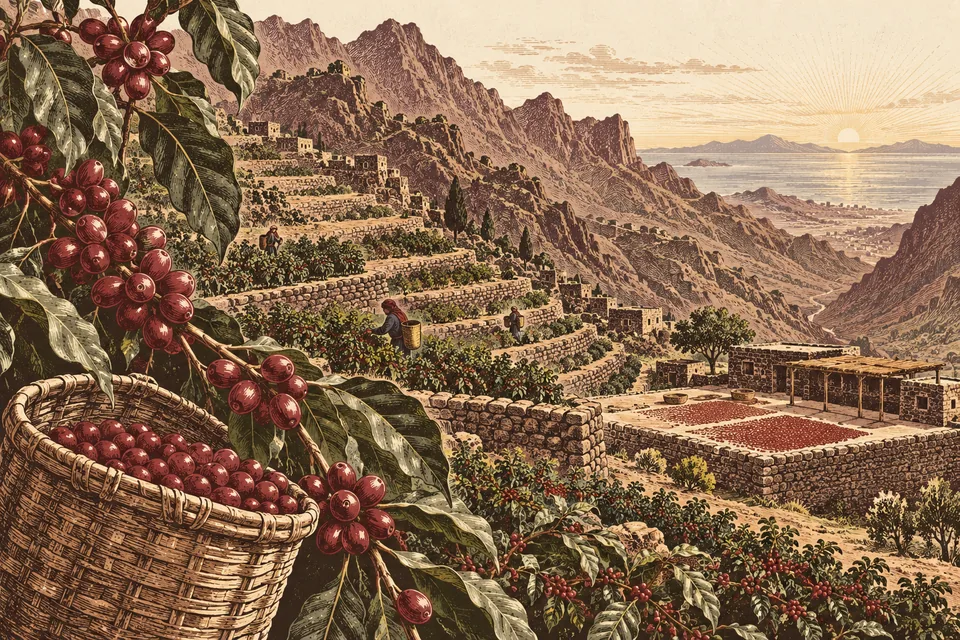
The Food and Agriculture Organization of the United Nations (FAO) published a feature on 1 October describing Yemen’s coffee heritage and the conditions facing growers. FAO gives approximate sector figures of about 120,000 smallholder farmers cultivating coffee on nearly 35,000 hectares. Production is concentrated on terraces in the western highlands and relies on traditional methods. These are approximate descriptions of sector size, not a definitive annual census of farmers or planted area. The announcement does not quantify annual output, yields or the income of coffee-growing households.
Yemeni coffee also has a distinct place in the history of global trade. The name Mocha is associated with Al-Makha, a Red Sea port that was once an important point of departure for the coffee trade. That historical link does not mean that today’s growers automatically receive high incomes. FAO presents coffee as a livelihood, a cultural inheritance and an agricultural development opportunity. Each dimension depends on current production conditions, how much value is added to the crop and the channels through which farmers can reach buyers.
The agency lists political instability, limited access to agricultural inputs, water scarcity, climate impacts, low market prices and aging trees among the sector’s main pressures. These constraints are connected. Growing a quality crop can become economic value only when farmers can process it appropriately after harvest and connect with buyers. FAO’s feature describes the work it supports, but it does not give the price growers receive, a measured increase in output or a new export volume. Those results are not quantified, so the initiative’s effect on income or production cannot yet be stated with certainty.
Under FAO’s One Country One Priority Product initiative, coffee has been selected as a distinctive Yemeni agricultural product. A national working group or task force has been established to manage the Coffee Centre in Aden. A value-chain assessment, an upgrading strategy and an investment plan have also been prepared. These steps provide a basis for coordination; they do not prove that a new facility has been fully financed, that an investment is complete or that credit has reached growers. The plans’ effect on the ground will depend on financing, clear institutional responsibilities and farmers’ ability to access resulting support.
FAO’s stated areas of support include better agricultural practices and farmer knowledge, processing capacity, value addition and market opportunities. These steps could help the sector move beyond sales of unprocessed coffee, but the announcement names no target markets, dated production goal or export earnings. It would therefore be inaccurate to describe expansion as an achieved result. FAO also notes that coffee husks are used to prepare qishr, a traditional Yemeni drink. That detail shows that coffee is more than a commodity, while terrace cultivation carries knowledge passed between generations.
FAO published the feature for International Coffee Day on 1 October, linking this heritage with its value-chain development agenda. Two numerical limits matter when reading the story: about 120,000 growers and nearly 35,000 hectares are approximate scope indicators supplied by FAO, not annual harvest, yield or farmer-income figures. The second limit is that a working group, assessment and plan demonstrate institutional preparation, not measured success. Future official data on investment, quality, the number of buyers, yields and exports would allow progress to be assessed more directly.


