Story details
The International Energy Agency (IEA) set out options for managing natural-gas supply disruptions in its Gas Reserve Mechanisms and Flexibility Options report, released on 9 September. The agency says two major supply crises in the past five years challenged assumptions about the resilience of global gas markets. After Russia’s 2022 invasion of Ukraine, a sharp drop in pipeline gas deliveries to Europe contributed to record prices and a reconfiguration of global liquefied natural gas (LNG) trade. Disruptions to LNG flows through the Strait of Hormuz during the 2026 Middle East conflict again exposed the vulnerability of import-dependent economies.
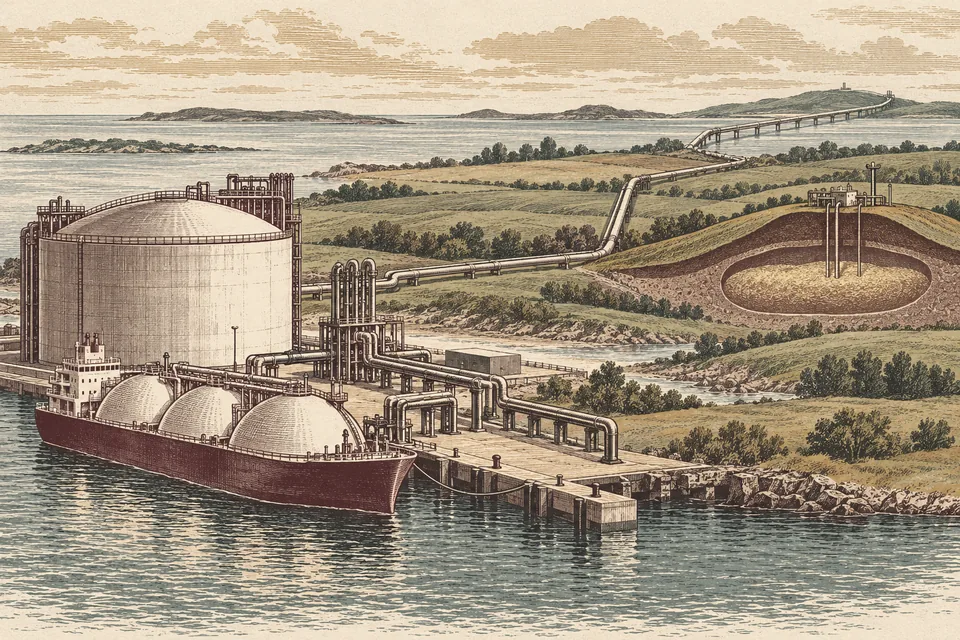
The report treats physical storage as one foundation of supply security. Options include underground gas storage, LNG tanks and floating storage. But the IEA says storage alone cannot address every disruption and that the availability of infrastructure differs considerably among countries and regions. New storage can be expensive and take years to build. The amount held is only part of the question: its connection to the network, the time required to release it and who can access it during a crisis also matter.
Commercial flexibility is a second tool that can complement physical storage. More flexible LNG contracts and cargo swaps could help move available supplies toward markets where demand is higher. Such arrangements may redistribute supply and moderate price volatility without major new infrastructure. Still, competition for limited LNG cargoes during acute stress can intensify price swings and may not prevent physical shortages. The IEA highlights the value of flexibility while making clear that it is not guaranteed insurance against every supply risk.
The report also examines policy-based reserve mechanisms governments could consider in light of their circumstances. These include mandatory storage obligations, strategic gas reserves and buffer LNG arrangements. Options identified for further consideration include joint strategic reserves using existing infrastructure, cross-border stockholding, cross-regional LNG buffers and pooled LNG call options that could be exercised in an emergency. These are not all existing or operational reserves; the IEA discusses them as possible designs. A country’s infrastructure and market rules will determine which mechanisms can work.
The IEA stresses that there is no single model suitable for every country. Geography, pipeline and LNG infrastructure, import dependence, market design and existing storage capacity all affect the choice. In some settings, the cost and development time of new underground storage may make shared use of existing assets or more flexible contracts relatively attractive; other systems may need a different mix. The report does not rank countries against one reserve standard. It calls for analysis of national conditions and potential disruption scenarios before choosing an approach.
The agency recommends deeper government dialogue on gas security, more transparency about reserves and market conditions, regular emergency exercises and work to improve LNG-market flexibility. It also proposes examining voluntary international reserve arrangements, drawing on lessons from the IEA’s long-standing oil-security framework. These are policy recommendations; they do not mean that every government has built a reserve or accepted a shared arrangement. Implementation would require clear rules on costs, responsibilities, access and allocation during an emergency.
The 2022 and 2026 crises are examples of different channels through which supply can be affected, not forecasts of future gas prices. The IEA argues that reserve and flexibility measures have costs before a crisis, much like insurance, while the economic cost of being unprepared can be significantly higher. The assessment does not give one savings figure for every country. Decision-makers comparing storage, contractual flexibility and shared options would need to calculate costs using their actual infrastructure, exposure and market data.
The report’s practical contribution is to avoid equating gas security solely with construction of new tanks or storage caverns. Physical inventories, commercial flexibility, policy tools and international cooperation are presented as layers that address different risks. Judging what combination will work requires country-specific information about existing storage, LNG suppliers and routes, demand patterns and emergency plans. The IEA announcement does not disclose a new national reserve volume or a binding target; it presents options and principles for preparation.